How to Master TOEFL iBT Vocabulary Without Cramming: A Scientific Guide
Master high-frequency academic vocabulary for TOEFL iBT Reading, Listening, Speaking, and Writing using context sentences and modern FSRS spaced repetition.
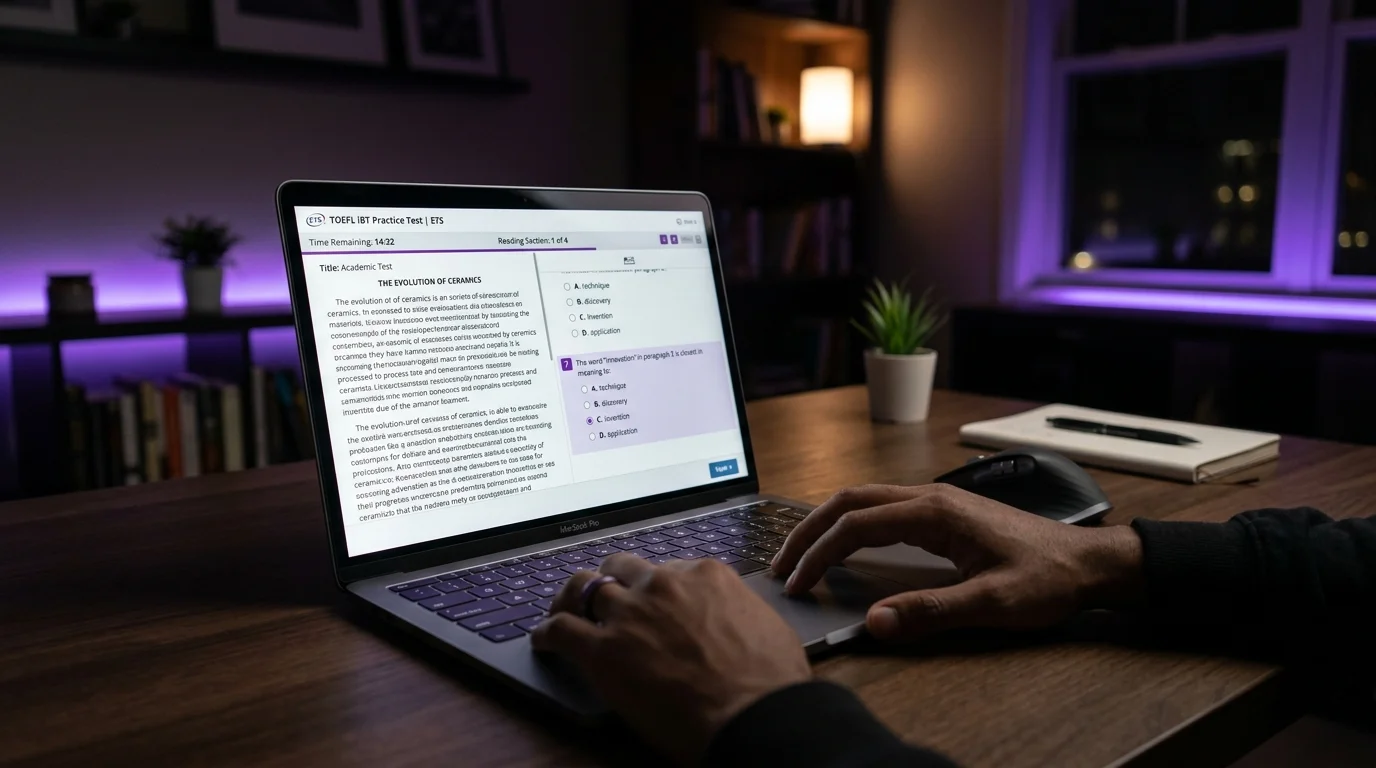
Preparing for the TOEFL iBT can feel intimidating when you encounter passages on paleontology, atmospheric physics, Renaissance history, or behavioral economics. Test takers often feel pressured to memorize thousands of obscure dictionary entries, only to find themselves stuck during timed exam sections.
The TOEFL iBT does not reward mindless memorization of rare words. Instead, Educational Testing Service (ETS) assesses whether you can quickly parse university-level English, understand nuanced vocabulary in context, and express complex arguments accurately in your speaking and writing.
In this guide, we break down the vocabulary skills that produce high scores, examine high-frequency word patterns across university subjects, and provide a structured study system using active recall and spaced repetition.
The Three Most Common TOEFL Vocabulary Mistakes
Most candidates struggle not because they lack study hours, but because their study habits fail to build durable memory pathways:
- Studying Words in Isolation: Memorizing a two-word definition such as adversely = badly does not prepare you for real exam passages. In the Reading section, you need to understand how adversely pairs with verbs like affect, impact, or influence.
- Overlooking Secondary Meanings: In academic writing, common words frequently take on secondary definitions. For example, while harbor commonly means a seaport, a TOEFL biology passage might describe how animals harbor bacteria, or a history text might explain why philosophers harbor deep reservations about political authority.
- Passive Word-List Re-Reading: Highlighting vocabulary handbooks creates a false sense of mastery known as the illusion of competence. As explained in our guide on active recall vs passive reading, real retention happens only when you force your brain to retrieve words from memory.
If you are transitioning to academic English from an intermediate level, building a strong core with 504 Absolutely Essential Words first will give you the baseline needed for specialized exam material.
High-Frequency Academic Vocabulary Across TOEFL Disciplines
TOEFL reading passages and lecture recordings draw heavily from undergraduate curriculum topics. Familiarity with the vocabulary patterns of these academic fields helps you predict text structures and answer questions faster:
| Academic Discipline | High-Frequency Terms | Context Sentence Example |
|---|---|---|
| Geology & Climate | strata, precipitate, erosion, tectonic | "Tectonic shifts precipitate significant volcanic activity along continental plates." |
| Biology & Ecology | symbiosis, proliferate, adverse, niche | "Certain marine organisms proliferate rapidly even under adverse environmental conditions." |
| Anthropology & History | hierarchy, excavate, artifact, antecedent | "Archaeological excavations revealed a sophisticated social hierarchy within the ancient settlement." |
| Economics & Sociology | incentive, demographic, allocate, disparity | "Government agencies allocate specialized grants to reduce regional demographic disparities." |
| Psychology & Cognition | innate, stimulus, cognitive, reinforce | "Cognitive psychologists debate whether particular behavioral tendencies are innate or learned." |
Notice that high-scoring academic terms are not archaic oddities. They are functional, high-utility verbs, nouns, and modifiers that connect ideas logically.
Vocabulary Strategy Across the Four TOEFL Sections
Each section of the TOEFL iBT requires a tailored approach to vocabulary:
1. Reading: Mastering Vocabulary-in-Context Questions
Every TOEFL Reading passage features direct vocabulary questions asking which word is closest in meaning to a highlighted term.
To solve these reliably:
- Do not rely on dictionary knowledge alone, because multiple answer choices may be valid synonyms in other settings.
- Substitute each choice back into the sentence to see which preserves the exact tone, grammatical agreement, and logic of the passage.
- Pay attention to transition words like consequently, nevertheless, and substantiate to identify whether the surrounding sentences contrast with or expand upon the target word.
2. Listening: Campus Life vs. Academic Lectures
The Listening section splits into casual university interactions (conversations between students and professors or staff) and academic lectures.
- For conversations, study practical campus collocations like audit a course, prerequisite, office hours, and registrar.
- For lectures, focus on discourse signposts that signal main points, such as on the other hand, to put it another way, or the crucial takeaway is.
3. Speaking: Clarity and Varied Lexical Resource
In the Speaking section, test scorers look for clear pronunciation, natural pacing, and precise language. You do not need overly flowery vocabulary, but repeating words like good, bad, or big keeps your score in the 20 to 22 range.
- Upgrade basic descriptive words: replace big change with substantial shift, or solve a problem with mitigate a risk.
- Use consistent discourse connectors to organize your 45-second responses smoothly: first and foremost, in addition, consequently.
4. Writing: Integrated and Academic Discussion Tasks
In the Academic Discussion task and the Integrated Writing task, vocabulary precision demonstrates academic readiness:
- Paraphrase key ideas from the listening lecture rather than copying sentences verbatim from the reading passage.
- Vary your reporting verbs: instead of repeatedly writing the professor says, use the lecturer contends, the speaker disputes, or the author posits.
A Realistic 8-Week TOEFL Vocabulary Blueprint
To retain hundreds of academic words without burning out, spread your study sessions into small, daily habits powered by spaced repetition:
| Study Phase | Primary Objective | Daily New Words | Daily Study Time |
|---|---|---|---|
| Weeks 1 – 3 | Core Academic B2 Words | 15 – 20 words | 10 – 12 minutes |
| Weeks 4 – 5 | Scientific and Historical Terminology | 15 words | 12 – 15 minutes |
| Weeks 6 – 7 | Paraphrasing and Academic Collocations | 10 words + Review | 10 – 12 minutes |
| Week 8 | Full-Length Practice Test Consolidation | Review Queue only | 8 – 10 minutes |
Consistency beats long weekend cramming sessions. Spending ten minutes every morning reviewing words right before you forget them flattens the forgetting curve and saves hours of re-study. You can read more about how automated scheduling works in our guide on the science of spaced repetition.
Study Curated TOEFL Decks on Vocabify for Free
You do not need to spend hours compiling spreadsheets, looking up phonetic guides, or formatting paper cards.
Vocabify provides comprehensive, pre-built decks designed specifically for TOEFL iBT candidates:
- 550 Must-Know Words for TOEFL iBT flashcard deck: Covers 549 high-frequency academic items across CEFR B2 and C1 levels, complete with dual US/UK audio pronunciations, accurate phonetic symbols, and realistic example sentences.
- 400 Must-Have Words for the TOEFL deck: Based on the classic McGraw-Hill curriculum, organized into targeted subject areas so you can master related terms together.
Both collections integrate directly with modern FSRS algorithms, giving you a custom study schedule that adapts to your recall speed. Explore our complete curated deck library to start practicing online for free, or learn about our full feature set on the features page.
Master English Vocabulary Faster with Vocabify
AI-generated flashcards, modern FSRS spaced repetition, and curated exam decks, 100% free.
Start Free with Vocabify